
Pool Deck and Patio in Bucks County PA: Choosing a Surface That Survives Winter
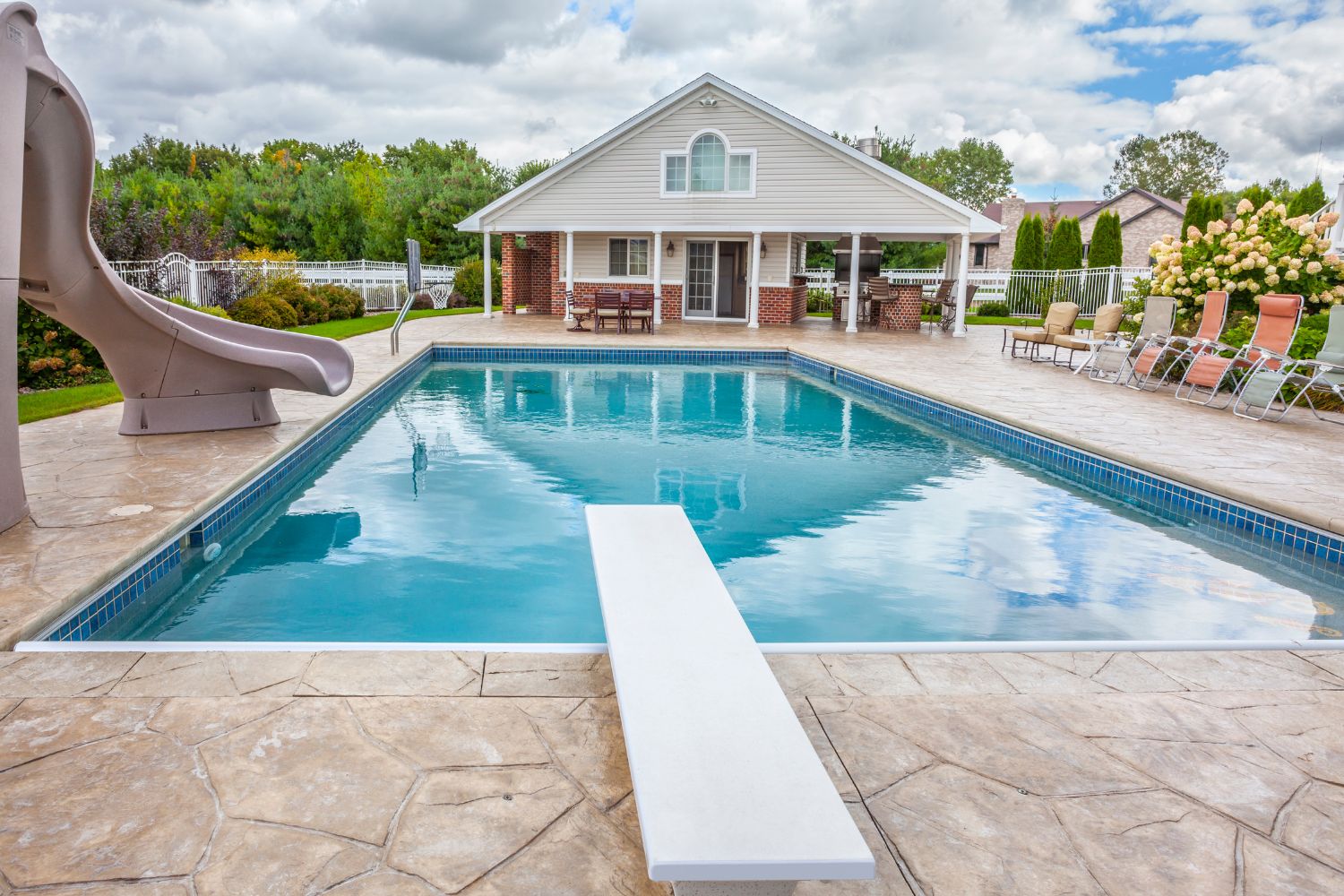
The pool is the thing people look at. The deck is the thing they stand on for four hours.
Get the pool deck and patio wrong and you notice it every single day. It is too hot to walk on in July. It is slick when wet. It cracked in the third winter and now there is a lip that catches a toe. Or it is simply too small, because someone laid four feet of concrete around the coping and called it done, and now six chairs do not fit without somebody sitting in a flower bed.
A good pool deck and patio in Bucks County PA has to do three unglamorous jobs. Stay cool under bare feet. Stay grippy when wet. Survive a Pennsylvania freeze-thaw cycle without breaking apart. Everything else is aesthetics.
The Freeze-Thaw Problem Every Pool Deck and Patio in Bucks County PA Faces
This is where southeastern Pennsylvania is different from Florida or Arizona, and it is why national decking advice falls apart on a pool deck and patio in Bucks County PA.
Water gets into a joint or a pore. It freezes overnight and expands roughly nine percent. It thaws the next afternoon. Then it does it again. We can run through dozens of those cycles in a single winter across Bucks County, Montgomery County, and Chester County.
Any pool deck and patio surface that absorbs water and cannot flex will eventually spall, crack, or heave. That is not a defect. That is physics meeting a material that was not spec’d for it.
Two things protect a pool deck and patio in Bucks County PA against it. Drainage that actually moves water away from the pool rather than toward it, and a base that was compacted properly before anything went on top of it. Most deck failures we are called to fix are base failures wearing a surface problem as a disguise.
Concrete: The Default, Done Well or Done Badly
Broom-finished concrete is the most common pool deck and patio surface in the region because it is the cheapest to install. That is the honest reason.
Done properly, with control joints in the right places, a good fiber or mesh reinforcement, and real attention to drainage slope, concrete lasts a long time and looks clean. Done badly, it cracks along a straight line within three winters and there is no fixing it. You can only cut it out.
The heat issue is real. Standard gray concrete gets punishing in direct sun. Lighter colors and textured cool-deck coatings help, and they are worth the upcharge if the pool faces south with no shade.
The honest tradeoff: concrete is affordable and it is a monolithic slab, which means when it cracks, you are not patching one piece, you are dealing with a scar.
Travertine: The One That Actually Stays Cool
If you have walked on a travertine pool deck and patio on a hot afternoon, you already know why people pay for it.
Travertine is a natural stone that reflects rather than absorbs heat, and it stays noticeably cooler underfoot than concrete. It is naturally textured, so wet traction is good without needing a coating. And because it is installed as individual pavers, a single damaged piece can be lifted and replaced without touching the rest of the deck.
The catch is that it is porous. In a freeze-thaw climate, travertine needs to be sealed and it needs a base that drains, or water will sit in the stone and work on it every winter. Installed on a proper compacted base with the right joint sand, it holds up well here. Installed on a lazy base, it moves.
It is also the premium option on price, and there is no way around that.
Pavers: Flexibility Where Concrete Cannot Bend
Concrete pavers and stone pavers sit between the two on cost and behave well in this climate for a specific structural reason. For a pool deck and patio in Bucks County PA, that reason matters more than looks. A paver deck is a field of small units with joints between them, so when the ground moves, the joints absorb it instead of the surface cracking.
Pavers also let you do things concrete cannot. Change the pattern where the patio meets the pool. Run a border in a contrasting color. Curve a seating area around a fire pit without a saw cut.
Upkeep is real but manageable. Joint sand needs refreshing. Weeds find gaps. A settled paver can be lifted and re-set, which is a repair concrete does not offer.
Size the Pool Deck and Patio Before You Fall in Love With the Material
This is the mistake we correct most often, and it costs nothing to avoid.
Before you choose a material for your pool deck and patio, walk the space with a tape measure and actually place things. Six lounge chairs need more room than you think. A dining table with chairs pulled out needs a genuine footprint. If you want an outdoor kitchen or a fire feature, that is not deck, that is a room, and it needs its own square footage.
Then think about traffic. There should be a clear path from the house to the pool that does not force people to walk between somebody’s chair and the water. And the deep end usually needs less deck than the shallow end, because that is not where people gather.
Our backyard patio and pool design page shows how we lay this out before a shovel goes in the ground, and our gallery is worth scrolling if you want to see scale rather than read about it.
Deck and Pool Should Be One Project
Here is a tradeoff worth taking seriously.
When a pool company builds the pool and a separate hardscape company builds the pool deck and patio, the seam between them is where problems live. Coping heights do not line up. Drainage runs the wrong direction. Nobody owns the transition. And when something moves in year two, each contractor points at the other.
Building the pool and the deck as one project means the elevations, the drainage, the coping, and the base are all one plan. That is how we approach outdoor living work generally, and it is why the full range of services sits under one roof.
It also matters on new construction. Our inground pool design and construction in Bucks County post covers the build sequence, and the deck is not an afterthought in it.
If Your Deck Is Already Failing
Most of the failing surfaces we are called to look at fall into two categories. Cracks that run in a straight line usually mean a control joint was missing or in the wrong place. Cracks that spider mean the base moved.
A slab that has heaved and now sits higher than the coping is a drainage failure, and resurfacing the pool deck and patio over it will not fix the cause. Neither will a coating. If water is running toward the pool instead of away from it, the fix is under the surface.
This is also the moment to think bigger. If you are already tearing out decking, and the pool surface is aging, doing both at once is meaningfully cheaper than doing them two years apart. That is covered in more depth in our post on choosing a pool contractor in Bucks County and Montgomery County, where scope and sequencing get decided.
Whatever surface you end up with, our inground pool maintenance guide for PA owners covers the seasonal habits that keep a deck from becoming a project again.
Let’s Design the Whole Space
We design and build pool deck and patio projects in Bucks County PA, along with Montgomery County and Chester County, in concrete, travertine, and pavers, as part of the pool build rather than bolted on afterward.
Send us the pool shape, the yard, and a rough idea of how you want to use the space. We will tell you which surface makes sense for your sun exposure, your drainage, and your budget, and we will size the deck around how you actually live rather than around the smallest number.
Start your pool deck and patio design and we will walk the yard with you.
FAQs
What is the coolest pool deck material for a Pennsylvania summer?
Travertine stays coolest underfoot because natural stone reflects heat instead of absorbing it. Light-colored concrete pavers are the next best option. Standard gray broom-finished concrete gets hottest, though a cool-deck coating or a lighter integral color helps meaningfully if the pool has full southern exposure.
Will pavers or travertine crack in a Pennsylvania winter?
Individual units handle freeze-thaw better than a poured slab, because the joints between them absorb ground movement instead of transferring it into a crack. The real variable is the base. A properly compacted base with drainage will hold up for decades. A rushed base will move regardless of what sits on top.
How big should a pool deck be?
Bigger than most people plan for. Measure the actual furniture you intend to use, add a clear walking path from the house to the water, and give any outdoor kitchen or fire feature its own footprint. Four feet of decking around the coping is a common shortcut and a common regret.
Can you replace a pool deck without touching the pool?
Yes. Deck replacement is its own project and the pool can stay as it is. That said, if the interior surface is also nearing the end of its life, combining the two saves real money on mobilization and yard protection compared with running them as separate projects.
Do you build the pool and the deck, or just one?
Both, as a single project. Keeping the pool, the coping, the deck, and the drainage under one plan is how you avoid elevation mismatches and the finger-pointing that happens when two contractors share a seam.


